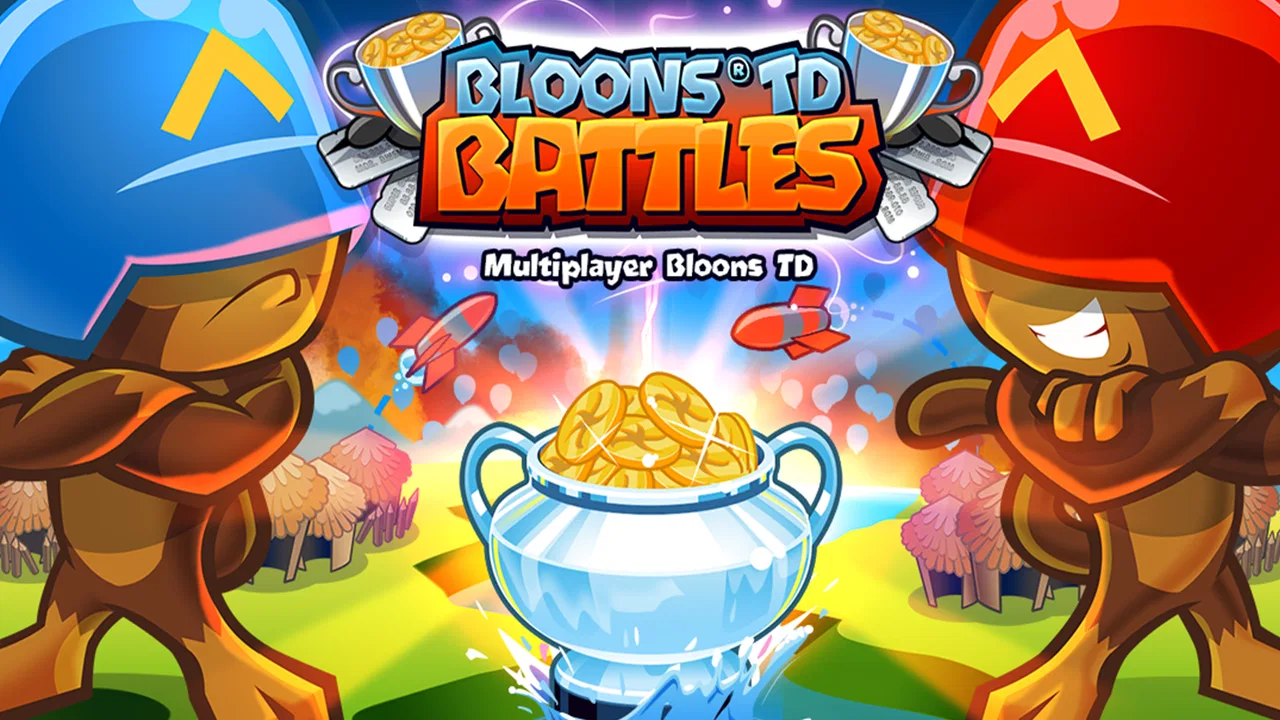
Bloons TD Battles
- 4.3
- Rating
- 10.00M
- Installs
- Free
- Price

 Analysis by App-foxy
I first came to Bloons TD Battles expecting a familiar tower-defense game with a competitive twist, and that is exactly where its appeal lies. It takes the recognizable monkey-versus-bloons idea and turns it into a direct contest against another player. Instead of simply surviving a fixed challenge, I have to build an economy, choose defenses, read an opponent’s plan, and decide when to apply pressure. That extra layer makes every round feel more personal than a standard tower-defense match.
This is a free strategy game from ninja kiwi, designed around real-time player-versus-player battles. It is rated for Everyone, runs on Android devices using at least Android 5.0, and the current version is 6.24. The game has been available since July 18, 2013, so it is not a new experiment; it is an established title that has had time to develop its own rhythm and audience. With an average rating of 4.3 from around 914 thousand ratings and more than 10 million installs, it clearly continues to attract a large player base.
How the current version feels to play
The basic match structure is easy to understand but difficult to master. I place monkey towers to stop incoming bloons while also sending bloons toward the other player. The money earned from those choices determines how quickly I can improve my defenses or increase the pressure on the opponent. A match can begin calmly, with both sides building a modest setup, and then change quickly when one player finds a weakness.
You May Also Like

 Blood Strike: 2.5 Anniversary
Blood Strike’s Loadouts Turn Every Drop Into a Tactical Gamble
A close look at Blood Strike’s custom loadouts: how fast access to signature weapons reshapes its battle royale rhythm, rewards preparation, and narrows the gap between fights.

 Pandora - Music & Podcasts
Pandora’s Music Is Easy to Start, but Harder to Recover
Pandora’s strength is its low-effort path from a seed to a station. Its weak spot is how much confidence it asks you to place in connection, setup, and quiet recovery.

 8 Ball Pool
 Is Built on Rivalries, Rematches, and Routine
A close look at the rivalries, rematches, shared routines, and unanswered safety questions that turn a quick pool match into a persistent mobile community.

 Samsung Music
’s Quiet Strength Is Playing What You Already Own
Its reach comes less from spectacle than from dependable access to a personal library. That simplicity is both the app’s strongest retention engine and its ceiling.

 AccuWeather: Weather Radar
AccuWeather Review: A Quick, Clear Forecast for Everyday Decisions
For everyday plans, the best forecast is the one you can understand quickly. AccuWeather makes rain timing, radar, and local conditions easy to act on, with a few trade-offs.

 Hill Climb Racing
Why Hill Climb Racing Still Turns Crashes Into One More Run
A tiny car, a bumpy hill and one more upgrade: Hill Climb Racing keeps resurfacing because its simple chaos makes every near-miss feel personal.
More From Our News Desk



That push and pull is the strongest part of the experience. In a regular tower-defense game, the main question is usually whether my arrangement can withstand the next wave. Here, I am also asking what the other person is preparing, whether they are saving money, and whether an attack now will force them to spend resources defensively. I often find myself making decisions that are not immediately optimal for survival because they may create a better position several rounds later.
The controls are suited to short mobile sessions. I can place towers, upgrade them, and send bloons without dealing with a complicated interface. That matters because a competitive game becomes frustrating when the controls create more difficulty than the strategy itself. Battles are still demanding, but the challenge mostly comes from timing and judgment rather than from wrestling with menus.
At the same time, the real-time format means that this is not a relaxing, pause-and-plan tower defense game. A poor decision can become expensive before I have time to reconsider it. Players who enjoy thinking through a level at their own pace may find the pressure uncomfortable. The game is better suited to people who like quick decisions and can accept that some matches will turn on a single mistake.
The economy is as important as the towers
One of the most useful lessons I learned is that placing more towers is not automatically the safest move. Every purchase has an opportunity cost. Spending too much early can leave me unable to respond to a sudden rush, while saving too aggressively can make my defenses collapse before the savings become useful. The best opening depends on the map, the opponent’s behavior, and the role I want to play in the match.
I also pay closer attention to the balance between income and immediate defense than I did when I first started. A tower that looks strong on paper may be the wrong choice if it delays an important upgrade. Conversely, a small upgrade at the right moment can stabilize a defense and leave enough money for a counterattack. This is where the game feels more like a competitive strategy title than a simple placement puzzle.
A practical habit is to decide what my next major purchase is before spending on minor improvements. That does not mean following a rigid build every time. It means keeping a clear financial target so that I do not waste money reacting emotionally to every bloon sent my way. When I ignore that discipline, I usually end up with several partially developed towers and no reliable answer to the next threat.
Reading the opponent changes the whole match
The opponent’s actions provide information even when they are not attacking. A sudden focus on income may suggest confidence in the current defense, or it may mean a large attack is being prepared. A player who upgrades early may be trying to remove the chance of a quick rush. I do not need to know every possible strategy to benefit from watching these patterns; I only need to notice when their spending changes.
This makes scouting more valuable than simply memorizing a favorite tower arrangement. A setup that works against one style can be vulnerable against another. I have had matches where my initial plan looked excellent until the opponent used a different type of pressure, forcing me to adjust instead of repeating the same sequence. That adaptability is one of the clearest signs that this game rewards experience.
My most useful advanced tip is to treat attacks as tests, not only as attempts to finish the opponent. A smaller, well-timed rush can reveal whether their defense has a gap or whether they are holding enough money to respond comfortably. If the attack fails but forces an expensive reaction, it may still have achieved something. This way of thinking prevents me from judging every move only by whether it immediately causes damage.
Why the long-running version matters
The July 2013 release date gives the game a different character from newer mobile strategy titles. It has had a long period to establish its identity, and the current 6.24 version shows that the product is still maintained as an active game rather than being left as a historical curiosity. I would not describe the experience as a brand-new reinvention, but its continued availability makes it easier for players to approach as a mature competitive title.
For an existing player, that maturity can be reassuring. The central design does not feel like a temporary trend built around a single novelty. The familiar tower-defense foundation remains understandable, while the player-versus-player format gives it enough depth to support repeated matches. Newcomers should still expect a learning curve, because a simple interface does not mean the strategy is simple.
The current state is also worth viewing realistically. A long-running competitive game can feel less welcoming when experienced players already understand efficient openings and common responses. I sometimes lose not because I fail to understand the immediate threat, but because the other player has planned several steps further. That gap can be discouraging, especially when I want a casual first session rather than a game that expects study through repeated play.
What existing players gain from the current build
Players returning after a break will find the same essential appeal: short, direct matches where defense, economy, and offense are connected. The current version is useful for someone who already enjoys the game because it preserves the competitive loop without requiring a completely different way to play. I can return for a few matches, remember the basics quickly, and then start noticing details I had forgotten about timing and resource management.
The game also works well as a focused break during an ordinary day. If I have a little free time, I can play a match that demands my attention without committing to a large campaign or a long story. A realistic example is a commute or a waiting period: I might begin with the intention of playing one battle, then stop after that match if I need to move on. The format is compact enough for that use, although the real-time pressure means I should not start a battle when I know I will be interrupted.
Another benefit for returning users is that the game rewards reviewing mistakes. After a loss, I can usually identify a decision that mattered: I invested in income too early, failed to prepare for a particular kind of pressure, or attacked without considering the opponent’s response. That makes defeat more useful than it would be in a game where the result feels determined by hidden randomness. I still dislike losing, but I can often turn the match into a lesson.
Where it differs from ordinary tower defense
Compared with a traditional single-player tower-defense game, this one has less room for experimentation without consequences. In a solo campaign, I can replay a level, test an unusual tower combination, and learn at my own pace. In a live battle, experimentation affects another person and may cost me the match. That makes the game more exciting, but it also makes it less suitable for players who mainly want a sandbox.
Compared with slower strategy games, it offers less time for broad planning and more emphasis on immediate adaptation. I do not spend long building a perfect empire or managing a large map. Instead, I manage a compact battlefield where a few purchases can change the balance. This makes it more approachable than a complex grand-strategy game, but less satisfying for anyone who wants deep long-term management outside the match itself.
It also differs from purely casual arcade games because the decisions accumulate. A rushed placement or careless upgrade may not cause an instant loss, yet it can reduce the options available several rounds later. I like that consequence because it gives ordinary actions strategic weight. However, it means the game is not ideal when I want something I can play with almost no concentration.
Free to start, with a monetization trade-off
The game is free to download and play, which makes trying it straightforward. That is important for a competitive title because I can learn whether its pace suits me before making any financial commitment. In-app purchases range from $0.99 to $99.99 per item, so I would approach the purchase system carefully rather than assuming every optional expense is necessary.
My advice is to play enough matches to understand the core loop before spending money. A purchase cannot replace learning when the main challenge is reading the opponent and managing resources. If I am losing because I do not recognize a threat or misjudge my economy, buying something is unlikely to solve the real problem. For a new player, patience is more valuable than immediately trying to accelerate progress.
The trade-off is that free-to-play design can make a competitive game feel more complicated than a one-time purchase. Some players are comfortable with that model, while others prefer paying once and receiving a clearly bounded experience. If avoiding in-app purchases is a major priority, I would compare this game with premium tower-defense alternatives before committing to it as a main game.
Small habits that improve the first matches
I recommend starting with one dependable plan rather than trying to understand every option at once. Learn how your early defense handles ordinary pressure, then add one offensive idea and one emergency response. This gives each match a purpose. Instead of randomly changing towers after every loss, I can identify whether the problem was weak defense, poor income timing, or failure to react to the opponent.
It is also worth watching the battlefield rather than staring only at the upgrade area. The opponent’s choices, the timing of incoming bloons, and the shape of my own defense all provide clues. I have played better when I periodically checked the whole situation before making a purchase. That brief pause in attention is often enough to prevent an automatic upgrade that does not fit the current threat.
One less obvious trade-off is that a defensive lead can become a trap if it encourages passivity. I may feel safe because my towers are handling the present wave, but the other player may be building a stronger economy and preparing a later attack. Conversely, constant aggression can leave my own side fragile. The strongest play usually comes from switching roles when the match demands it rather than deciding that I am always an attacker or always a defender.
Who should play it, and who should skip it
I would recommend it to players who like strategy with immediate feedback, competitive mobile matches, and the satisfaction of improving through repeated decisions. Fans of tower defense will recognize the foundation, while players who enjoy head-to-head games will appreciate the added mind game. It is especially good for someone who wants a free title that can be learned quickly but not mastered in a single evening.
I would be more cautious recommending it to people who dislike real-time competition, interruptions, or losing to a more experienced opponent. It is also not the best choice for anyone looking for a story-driven campaign, a peaceful building game, or a completely offline-feeling experience. The appeal depends on the tension between two players, so those who want a predictable solo challenge may be happier with a conventional tower-defense alternative.
Parents should also note the Everyone content rating while remembering that competitive play can still feel intense even when the subject matter is light. The cartoon presentation makes the game approachable, but the pressure of a close match is real. I would introduce it to a younger player by emphasizing fair play and treating losses as part of learning rather than as a reason to spend money.
What I would like to see watched over time
For future updates, I would pay attention to how the developers maintain the balance between familiar strategies and meaningful adaptation. A competitive game stays healthy when established players have reasons to rethink their habits, but changes should not make the original tower-defense logic unrecognizable. The current version suggests an ongoing product, so long-term players will naturally care about whether future changes keep matches varied without making older knowledge worthless overnight.
I would also watch how approachable the game remains for newcomers. The large existing audience is a strength because it gives the title a recognizable community, but it can raise the barrier for someone entering without experience. Clear learning support, sensible progression, and a fair path to understanding the battlefield matter just as much as adding new reasons for experts to return.
Finally, I would keep an eye on the balance between free access and optional spending. The free entry point is one of the reasons I can recommend trying it, while the wide range of possible purchase prices means players should make deliberate choices. The best future direction would preserve the feeling that smart play matters more than spending, because that is what makes the battles satisfying in the first place.
After spending time with it, I see Bloons TD Battles as a focused, competitive strategy game rather than merely a quick cartoon distraction. Its strongest moments come from predicting another player, protecting an economy, and turning a small advantage into a well-timed attack. Its main weaknesses are the pressure of live matches, the learning curve created by experienced opponents, and the need to be thoughtful around optional purchases.
For me, it earns a recommendation when I want a mobile game that makes a short session feel meaningful. I would not choose it for a calm, interruption-friendly break, but when I have the attention to concentrate, it gives tower defense a sharper edge. The combination of accessible controls, lasting strategic depth, and a current version that continues the game’s established direction makes it worth trying—especially if you enjoy discovering why a match was won or lost rather than simply watching a level end.
FAQs for Bloons TD Battles
01What is Bloons TD Battles?
Bloons TD Battles is a real-time multiplayer game where players compete in head-to-head tower defense battles. Developed by Ninja Kiwi, it features strategic gameplay where you must pop balloons (bloons) before they reach your defenses. Players can choose different maps, towers, and strategies to outsmart their opponents.
02Is Bloons TD Battles free to play?
Yes, Bloons TD Battles is free to download and play on both Android and iOS platforms. However, the game does offer in-app purchases for various items, such as new towers, power-ups, and cosmetic upgrades. These purchases can enhance gameplay but are not necessary to enjoy the full experience.
03What are the system requirements for Bloons TD Battles?
Bloons TD Battles requires Android 4.1 or later and iOS 9.0 or later. The game is compatible with most modern smartphones and tablets, but for optimal performance, it's recommended to have a device with a decent processor and sufficient RAM to handle the game's graphics and real-time multiplayer features.
04Can I play Bloons TD Battles with friends?
Absolutely! Bloons TD Battles features a multiplayer mode where you can challenge your friends in exciting tower defense battles. You can either invite friends directly or compete against random players worldwide. The game offers a competitive edge, making it fun to strategize and see who comes out on top.
05Does Bloons TD Battles require an internet connection?
Yes, an internet connection is required to play Bloons TD Battles, especially for multiplayer matches. The game relies on real-time interactions and leaderboards, so a stable internet connection ensures smooth gameplay and reduces the chances of disconnection during matches.
Pros
- Engaging multiplayer battles.
- Wide variety of towers and upgrades.
- Smooth and intuitive controls.
- Frequent updates with new content.
- Strategic depth with different tactics.
Cons
- Can be pay-to-win at higher levels.
- Some connectivity issues in multiplayer.
- Graphics may feel outdated to some.
- Limited tutorial for new players.
- Ads can be intrusive at times.

Bloons TD Battles
Gallery